Communication: How Baby Learns to Talk
When most of us hear the word "communication," we think of talking. But for Baby, communication starts long before their first word! Every cry, coo, smile, reach, and wiggle is Baby telling you something. And every time you respond, you're teaching them that communication is a two-way street. That back-and-forth is where language, connection, and learning all begin.
⚑ How Communication Develops
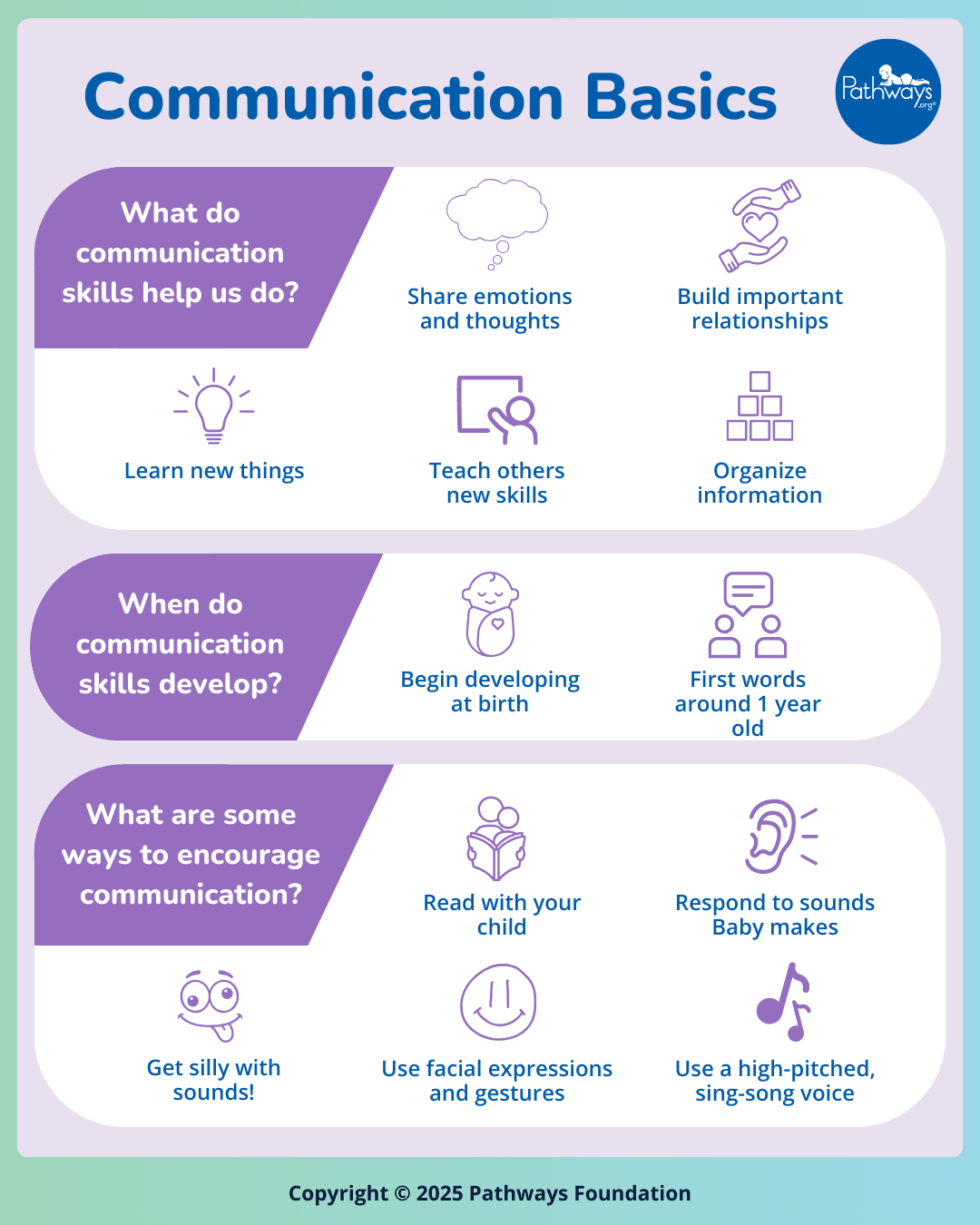
Baby begins to develop two sets of communication skills from birth: receptive skills and expressive skills. Understanding (receptive language) usually develops faster than expression (expressive language), so Baby often understands much more than they can yet say.
Receptive Communication
Baby's ability to take in and understand messages.
For example: turning toward your voice, quieting at familiar sounds, and eventually following simple directions.
Expressive Communication
How Baby sends a message back.
For example: crying, coos, and babbles; body language and gestures, such as waving; and eventually meaningful words.
Why Communication Matters
Developing strong communication skills is foundational for many areas of growth, including:
Social connection. Communication builds bonds with caregivers, siblings, and others. It lets Baby share joy, curiosity, affection, and even frustration, and helps them feel seen, understood, and safe.
Emotional regulation. When Baby has tools to communicate their wants and feelings, they feel less frustrated and more confident expressing themselves.
Learning & cognitive growth. Communication skills help Baby label the world, ask questions, think in ways beyond what they immediately see, and gradually understand more abstract concepts.
Communication Development by Age
Communication skills build fast in the first few years. Open your child's age range below to see what milestones to expect and watch for at each stage:
Baby's 1st Year (0–12 months)
Cries, coos, smiles, and gestures are all ways Baby "talks" with you before words arrive. Every response you give shows Baby that communication is a two-way street.
0–2 Months
Crying, cooing, facial expressions, and body movements communicate needs
Eye contact begins around 1 month
Watch for their first real smile!
2–4 Months
Turns toward voices and sounds
Starts making vowel sounds like "ooo" and "ahh"
Uses smiles, sounds, or movement to get your attention
4–6 Months
Babbling takes off (e.g., "ba-ba-ba")
First giggles arrive
Listens and responds when spoken to
6–9 Months
Starts connecting words to familiar people and objects
Responds to their own name
Uses simple gestures, like raising arms to be picked up
Anticipates verbal routines like "bye-bye"
9–12 Months
Imitates speech sounds and uses gestures to express themselves
Understands more words than they can say
May say "mama" or "dada" with meaning
Did you know? Partial or simplified words like "bah bah" (bottle) can count as Baby's first words. These are called word approximations. Learn about them here!
Baby's 2nd Year (12–24 months)
Vocabulary grows quickly in the second year, and by age 2, many toddlers are putting two words together. Baby understands much more than they can say!
12–15 Months
Points to familiar people and objects when named
May say one or two words beyond "mama" and "dada"
Copies what you do
15–18 Months
Imitates words and simple actions, like saying hello or blowing kisses
Follows basic instructions, such as "come here"
Begins pretend play
Vocabulary reaches at least 3 words
18–24 Months
Starts combining two words into short phrases like "more milk"
Uses simple pronouns like "me," "you," and "my"
Picks up new words quickly—this age is a language explosion!
2+ Years
Many parents can't understand everything their toddler says at first, and that's expected. It takes years to master all the sounds we use in speech.
2–3 Years
Vocabulary jumps to a minimum of 50 words, and two-word phrases begin
About half to 75% of what they say should be understood
Gets better at lip sounds like /b/, /p/, and /m/
3–4 Years
Says tongue sounds such as /g/, /k/, /t/, /d/, and /n/
By 4, you should understand most of what your child says
4+ Years
More complex sounds arrive: "sh", "ch", "j", /s/, /v/
Keeps mastering the trickiest sounds; "th" may take until 5–6 years
Helping Communication Skills Grow
These everyday habits support communication at any age:
Read together every day. Books introduce new sounds, words, and concepts. Point at pictures, name them, and ask simple questions.
Respond and imitate. When Baby babbles or gestures, respond with words or actions. This back-and-forth is called serve and return.
Sing and use a sing-song voice. Rhythm, rhyme, and repetition make language fun and memorable.
Get down to their level. Eye-to-eye conversations and facial expressions make words and emotions easier to understand, for you both.
Narrate your day. Describe what you're doing and what Baby sees. For example: "We're putting on socks. One sock, two socks!"
Follow their lead. Talk about what interests them, whether it's a toy or the birds outside.
Use repetition. Repeat new words often, and echo back what your toddler says to help with pronunciation.
Model instead of correcting. If your toddler says "Ba! Ba!" for ball, respond with "Would you like the ball?" rather than correcting them directly. They'll pick up the right pronunciation over time.
When to Get Support with Communication
Baby communicates in many ways and develops at their own pace, but talk to Baby's healthcare provider if you notice:
In the first year:
Doesn't maintain eye contact during playful interaction
Is unresponsive to sounds or voices
Isn't babbling by 6 months
Doesn't respond to their name by 9 months
In the second year:
Shows no recognition of familiar words, such as "mama" or "doggy"
Doesn't make any attempts to communicate by 15–18 months
Isn't interested in interacting with others
At 2+ years:
Has difficulty speaking or gets frustrated trying to get words out
Speech doesn't become easier to understand as they get older
Develops speech disfluencies around age 4, or is still experiencing issues around age 5
Doesn't continue adding new words to their vocabulary
Early detection matters. To help you start the conversation, download our Communication Checklists (ages 0–36 months).
Who can help: A speech-language pathologist can support communication through verbal and nonverbal skills. You can also connect with your child's healthcare provider or your local early intervention office.