Baby’s First Diaper Changes: How Often to Change a Newborn’s Diaper and What to Expect
-PPb00-.png&w=3840&q=75)
Tracking Baby’s wet and dirty diapers can help caregivers and healthcare providers monitor Baby’s health.
Check Baby’s diaper every couple of hours and before and after feedings to help prevent discomfort and diaper rash.
In the first week, Baby’s poo changes quickly, starting as a blackish, tarry substance called meconium and later turning yellow or tan, depending on the feeding method.
Changing your newborn’s diaper probably doesn’t rank high on your list of things to look forward to when Baby arrives, but it will become a big part of their daily routine all the same. If you’re a first-time parent, you might have lots of questions about what to expect. From how many diapers Baby will go through to what’s normal for their first poos, we have the answers here!
How many diapers will Baby go through in a day?
Although the amount and frequency of diaper changes vary from baby to baby, expect to change anywhere from 8 to 12 diapers a day during the newborn months.
It’s a good idea to get in the habit of tracking Baby’s diapers as soon as you can. Tracking Baby’s diapers is not only helpful for planning how many diapers to buy, but it can also help you and Baby’s healthcare provider notice unusual changes and whether Baby is eating enough.
💡 Pro Tip: Use our Diaper Tracker in the free Pathways.org Baby Milestones App to easily log Baby’s diapers and discuss changes with Baby’s healthcare provider.
When to Change Baby’s Diaper
When Baby needs a change, your nose usually knows first! But in general, you should check Baby’s diaper every couple of hours and before and after feedings to prevent soiled diapers from staying on too long.
Other signs that Baby’s diaper may need changing include:
Their diaper is sagging or feels heavy
The wetness indicator line on their diaper changed color
Baby is fussy or crying out of discomfort
Preventing Diaper Rash
Diaper rash can occur if Baby’s wet or soiled diaper is left on too long. It’s most commonly seen in babies aged 8 to 10 months, but it can happen at any time.
To reduce the risk of Baby getting a diaper rash, make sure to:
Promptly change Baby’s diaper after each pee or poo and clean the diaper area thoroughly
Check that Baby’s diaper area is as dry as possible before putting on a fresh diaper
Let Baby’s bottom air out when you can! Doing a minute or two of Tummy Time before putting on their diaper can help.
-kVNy0z.png&w=3840&q=75)
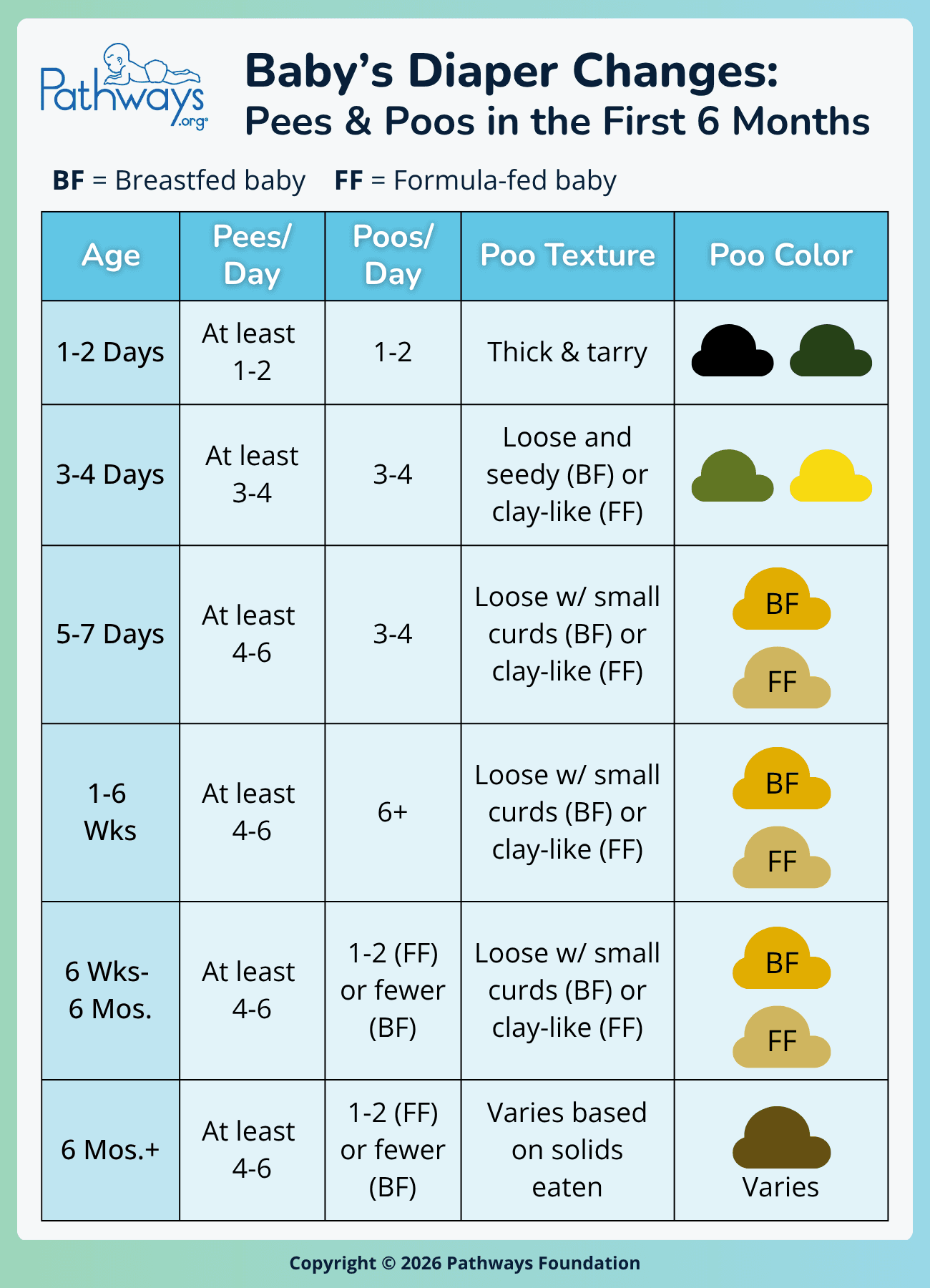
Wet Diapers and Poop Changes in Baby’s First Week
Baby will have just 1 or 2 wet diapers in their first days. This number will go up as their liquid intake gradually increases. A good rule of thumb for pee frequency is that, up to day 5, Baby will have as many wet diapers as they are days old, according to Ann & Robert H. Lurie Children’s Hospital of Chicago.
As for poop, Baby’s very first one will be a black or green tarry substance. This is known as meconium, and it’s a mix of mucus, skin cells, and amniotic fluid that builds up in Baby’s intestines before birth. Once Baby passes it, their next few poos may be yellow or green. This is normal!
Both the color and consistency of Baby’s poop will depend on whether they are breastfed or given formula. After the first couple of days, breastfed babies’ poos will be mustard yellow and loose, with seed-like particles mixed in. Formula-fed babies’ poos will be yellow or tan in color and slightly firmer than those of breastfed babies. Green is not an unusual color to see from time to time.
Here’s what you can expect a breastfed vs. formula-fed baby’s diapers to look like in the first week after birth:
Breastfed Baby Diapers
Days 1-2: At least 1-2 wet diapers and 1-2 black/dark green, thick, tarry poos
Days 3-4: At least 3-4 wet diapers and 3-4 loose, seedy poos that are greenish/mustard yellow
Days 5-7: At least 4-6+ wet diapers and 3-4 loose and yellow poos with small curds
Formula-Fed Baby Diapers
Days 1-2: At least 1-2 wet diapers and 1-2 blackish/dark green, thick, tarry poos
Days 3-4: At least 3-4 wet diapers and 3-4 yellow/tan poos with a soft, clay-like consistency
Days 5-7: At least 4-6+ wet diapers and 3-4 yellow/tan poos with a soft, clay-like consistency
If your formula-fed baby has very firm poos, check that you are following the correct instructions for mixing your formula, and be sure to add the water to the bottle first.
Diaper Changes Beyond Baby’s First Week
After Baby’s first week, expect around 6 or more wet diapers and poos a day. By 6 weeks, Baby’s daily poops may decrease to 1-2 per day. While formula-fed babies should poop at least once per day, it’s normal for breastfed babies to go a few days between poos as they grow. You may also see occasional color variation. As long as Baby’s poos are not hard or dry (often a sign they are not getting enough fluid), white, or bloody, and they are gaining weight steadily, there should be no cause for concern. Once Baby starts solids, their poop will firm up and turn more brown.
Don’t let every diaper change be a battle with Baby! Here are some tips to make them go more smoothly.
Sources
CDC. “Newborn Breastfeeding Basics.” Infant and Toddler Nutrition, 18 Oct. 2024, www.cdc.gov/infant-toddler-nutrition/breastfeeding/newborn-basics.html. Accessed 6 Mar. 2026.
healthychildren.org. “Baby’s First Days: Bowel Movements & Urination.” Healthychildren.org, 14 Nov. 2024, www.healthychildren.org/English/ages-stages/baby/Pages/Babys-First-Days-Bowel-Movements-and-Urination.aspx. Accessed 6 Mar. 2026.
Hill, David L, and Tanya Altmann. Caring for Your Baby and Young Child: Birth to Age 5. 8th ed., American Academy of Pediatrics, Oct. 2024, publications.aap.org/aapbooks/book/768/Caring-for-Your-Baby-and-Young-Child-Birth-to-Age. Accessed 5 Mar. 2026.
Jana, Laura, and Jennifer Shu. “Changing Diapers.” Healthychildren.org, 19 May 2021, www.healthychildren.org/English/ages-stages/baby/diapers-clothing/Pages/Changing-Diapers.aspx. Accessed 6 Mar. 2026.
Kusma, Jennifer. “How Often, How Much, What Color: Your Newborn Poop and Pee Questions Answered.” Www.luriechildrens.org, 22 May 2024, www.luriechildrens.org/en/blog/what-to-know-about-newborn-poop-and-pee/. Accessed 6 Mar. 2026.
La Leche League International. “Poop and Pee in the Exclusively Breastfed Baby.” La Leche League International, 26 Oct. 2024, llli.org/poop-and-pee/. Accessed 6 Mar. 2026.
Mayo Clinic. “Baby Poop: What to Expect.” Healthy Lifestyle Infant and Toddler Health, 26 Jan. 2024, www.mayoclinic.org/healthy-lifestyle/infant-and-toddler-health/expert-answers/baby-poop/faq-20057971. Accessed 6 Mar. 2026.