Do the “Baby 180°” Every Day to Prevent Positional Plagiocephaly and Torticollis
Simple everyday position changes help Baby build strong neck muscles and maintain a rounded head shape.
Pathways.org’s “Baby 180°” is an easy habit you can use during sleep, feeding, and play to help prevent positional plagiocephaly and torticollis.
Tummy Time and reduced time in infant equipment also support healthy development.
As you go about your day with Baby, there’s one simple trick you can use to support healthy head and neck development: It’s the “Baby 180°!
We created this catchy term to help parents and caregivers remember to change Baby’s position often. Making the Baby 180° a daily habit can help reduce the risk of positional plagiocephaly and torticollis, two common conditions seen in infants.
What is the Baby 180°?
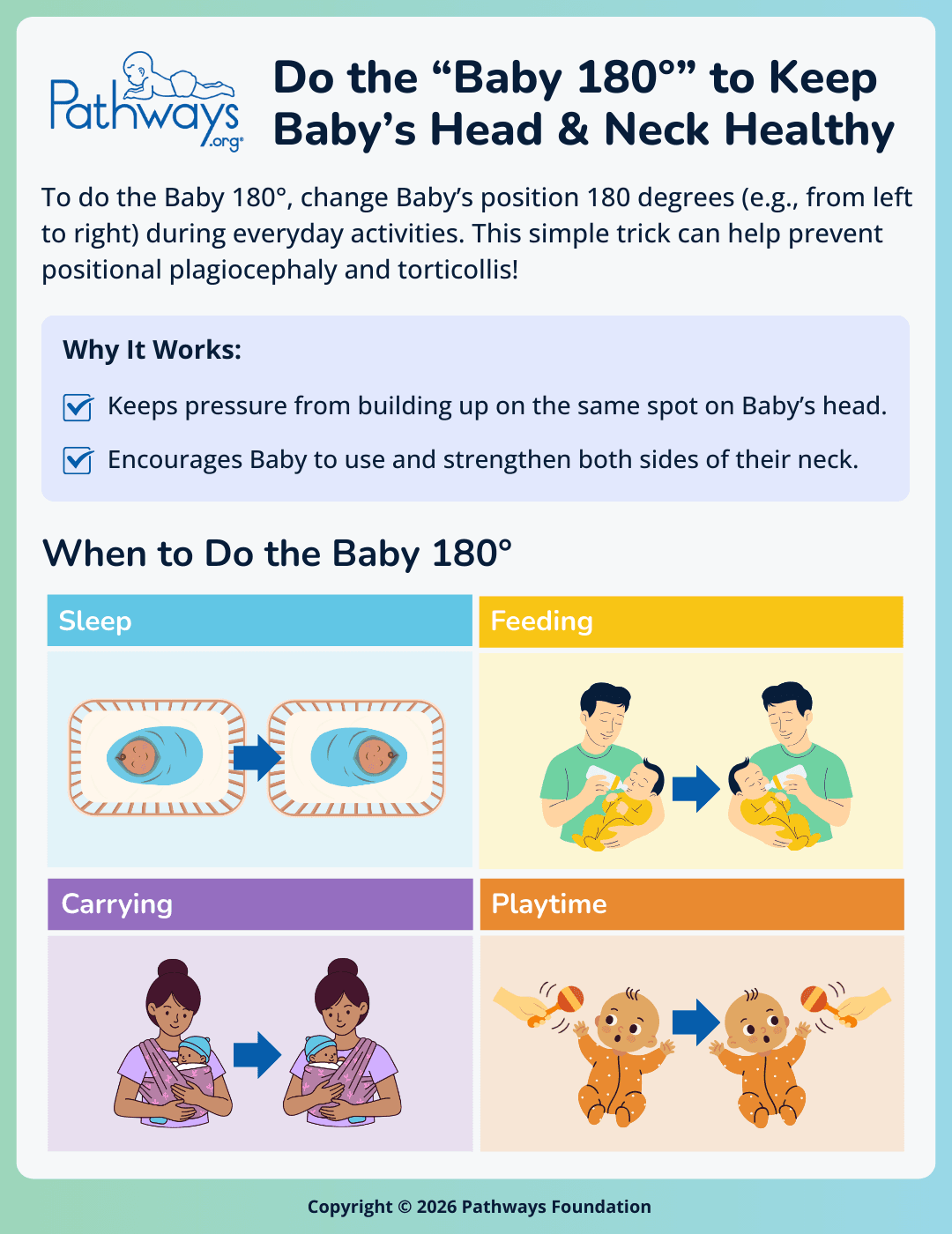
The Baby 180° is when you regularly change Baby’s position—180 degrees —during everyday activities, like sleep, feeding, and play. 180° means a half turn, or turning around so you’re facing the opposite direction. This could look like switching Baby from your left arm to your right arm when feeding them, or alternating the side of the changing table you change their diaper on.
Doing the Baby 180° ensures your baby doesn’t always face the same way, which is important for preventing positional plagiocephaly and torticollis. Changing Baby’s position often is also great for developing their overall strength!
Why it Works:
Changing Baby’s position keeps pressure from building up on the same spot on their head, helping prevent flat spots from forming (positional plagiocephaly).
It also encourages Baby to use and strengthen both sides of their neck, lowering the risk of tight neck muscles on one side (torticollis).
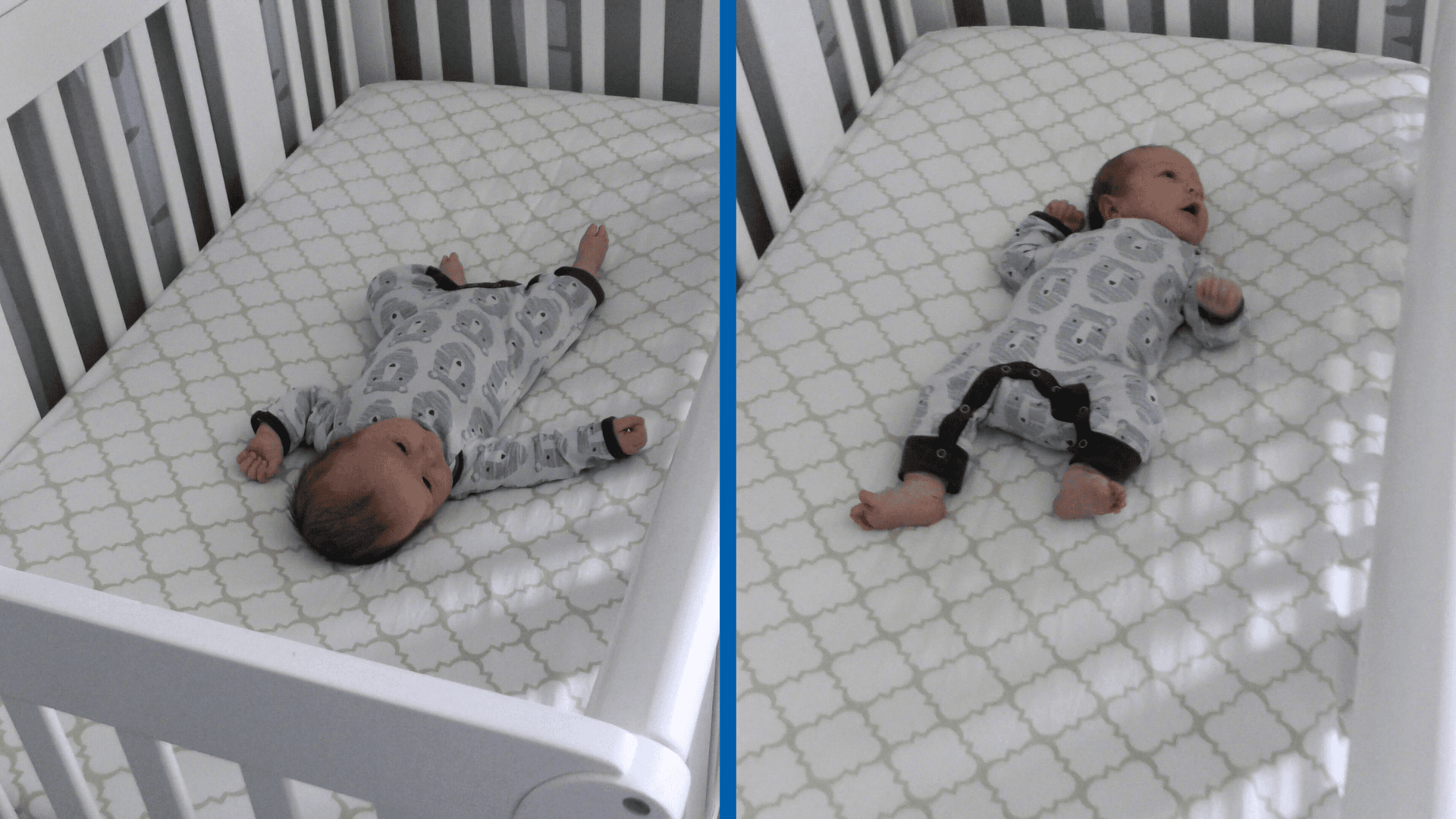
For example, when you lay Baby down on their back to sleep, they’ll often turn their head toward you or toward the direction of light or sound and fall asleep with their head in that direction. Alternating which end of the crib Baby’s head rests each night encourages them to look both ways, reducing pressure on one side and helping their neck stay flexible.
-N2KUSv.png&w=3840&q=75)
How to Use the Baby 180° During Baby’s Daily Routine
Doing the Baby 180° is easy! If you notice you always hold Baby on the same side or place them in the crib the same way each night, just switch it up! You don’t need to do the Baby 180° for every single activity. Simply being mindful about it throughout the day can make a big difference for Baby’s head shape and neck strength.
Try the Baby 180° During These Everyday Activities:
Sleep: Point Baby’s head to the left side of the crib one day and the right side the next (Baby should always sleep on their back!). Choosing one side for odd days and the other for even can help you remember.
Feeding: For bottle feeding, switch arms every few feedings. For breastfeeding, alternate which breast you start with (this can also help with milk flow).
Carrying: If you tend to hold Baby over your dominant shoulder, remember to switch to your non-dominant side now and then.
Playtime: When Baby is lying on their back or tummy, play from different sides. Get close with your face or a favorite toy to encourage them to turn their head to either side.
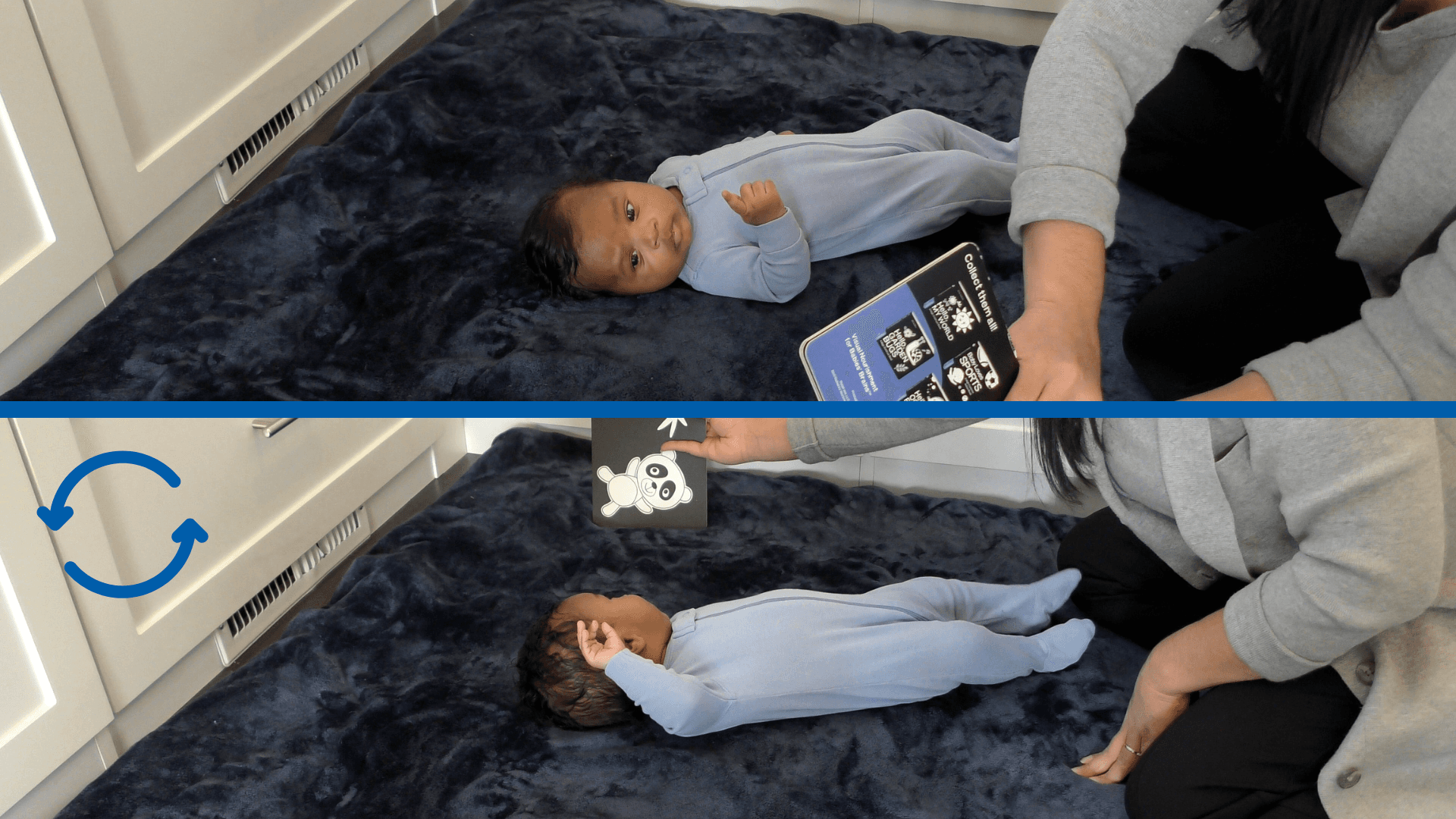
Diaper Changes: Every few changes, switch the side of the changing table you normally change Baby’s diaper on so Baby looks in a new direction.
Car Rides: If Baby always rests their head on one side of their car seat, gently guide it to lean the other way once they’re buckled in.
Bath Time: Try rotating Baby’s bath setup so they look toward you from the opposite direction.
You can stop doing the Baby 180° once Baby starts moving and changing positions more on their own.
What are positional plagiocephaly and torticollis?
Positional Plagiocephaly
Also called flat head syndrome.
Happens when one spot on Baby’s head (usually the back or side) becomes flattened from too much pressure in the same place.
May sometimes be caused by torticollis, because muscle tightness on one side of the neck can make Baby prefer to rest their head on the other side. $^3$
Cases of positional plagiocephaly are increasing every year because infants spend a lot of time in infant containers like car seats or carriers and sleep on their backs, which is critical for preventing sudden infant death syndrome (SIDS).
If not addressed, it can lead to facial asymmetries that may affect vision and hearing.
Torticollis
Also known as tight neck muscles on one side.
Occurs when the muscles on one side of Baby’s neck shorten and become tight, causing their head to tilt one way. It may also cause rotation on the opposite side of the neck.
May sometimes be caused by positional plagiocephaly. This is because gravity pulls Baby’s head toward the flat spot on their head, causing prolonged tension on one side of the neck.
Torticollis can affect posture and how movement patterns develop, and can cause Baby to prefer looking or turning to only one side.
Additional Tips to Help Prevent Positional Plagiocephaly and Torticollis
Along with the Baby 180°, these simple habits can help keep Baby’s head and neck healthy:
Do plenty of Tummy Time: Tummy Time strengthens Baby’s neck and core muscles and reduces time spent on the back. You can start as soon as Baby comes home! Learn more about doing Tummy Time with Baby.
Limit time in infant equipment: Too much time in strollers, car seats, or carriers can increase pressure on one part of the head. Learn more about limiting infant container use.
Sources
Jung, Bok Ki, and In Sik Yun. “Diagnosis and Treatment of Positional Plagiocephaly.” Archives of Craniofacial Surgery, vol. 21, no. 2, 20 Apr. 2020, pp. 80–86. PMC PubMed Central, www.ncbi.nlm.nih.gov/pmc/articles/PMC7206465/, https://doi.org/10.7181/acfs.2020.00059. Accessed 5 Dec. 2025.
Price, Angela. “Positional Plagiocephaly.” American Association of Neurological Surgeons, 30 Apr. 2024, www.aans.org/patients/conditions-treatments/positional-plagiocephaly/. Accessed 5 Dec. 2025.
Ann & Robert H. Lurie Children's Hospital of Chicago. “Torticollis Physical Therapy & Treatment.” Www.luriechildrens.org, www.luriechildrens.org/en/specialties-conditions/physical-therapy-for-torticollis/. Accessed 5 Dec. 2025.
Filisetti, Monica, et al. “Positional Plagiocephaly from Structure to Function: Clinical Experience of the Service of Pediatric Osteopathy in Italy.” Early Human Development, vol. 146, July 2020. ScienceDirect, www.sciencedirect.com/science/article/pii/S0378378220300530?via%3Dihub, https://doi.org/10.1016/j.earlhumdev.2020.105028. Accessed 5 Dec. 2025.