How Much and How Often Should I Feed My Baby?

Baby will tell you when they’re hungry! Practice responsive feeding by watching Baby’s hunger cues instead of feeding on a strict schedule.
Feeding amounts change as Baby grows and starts solids, but breast milk or formula remains Baby’s primary source of nutrition up until their first birthday.
Baby’s healthcare provider will track Baby’s growth and ask about their diapers to ensure they are eating enough.
Baby has a lot of growing to do, which means they’ll be very hungry as an infant! But because their stomach is so tiny (about the size of a cherry at birth!), Baby will eat several small portions spaced out throughout the day and night. The amount and frequency will change as their stomach gets bigger and their diet expands to include solids.
New parents often wonder how much their baby should eat and when, but it often depends on each baby’s needs and cues! This is why pediatricians recommend practicing on-demand feeding, or responsive feeding, with newborns.
What does it mean to feed Baby on demand (responsive feeding)?
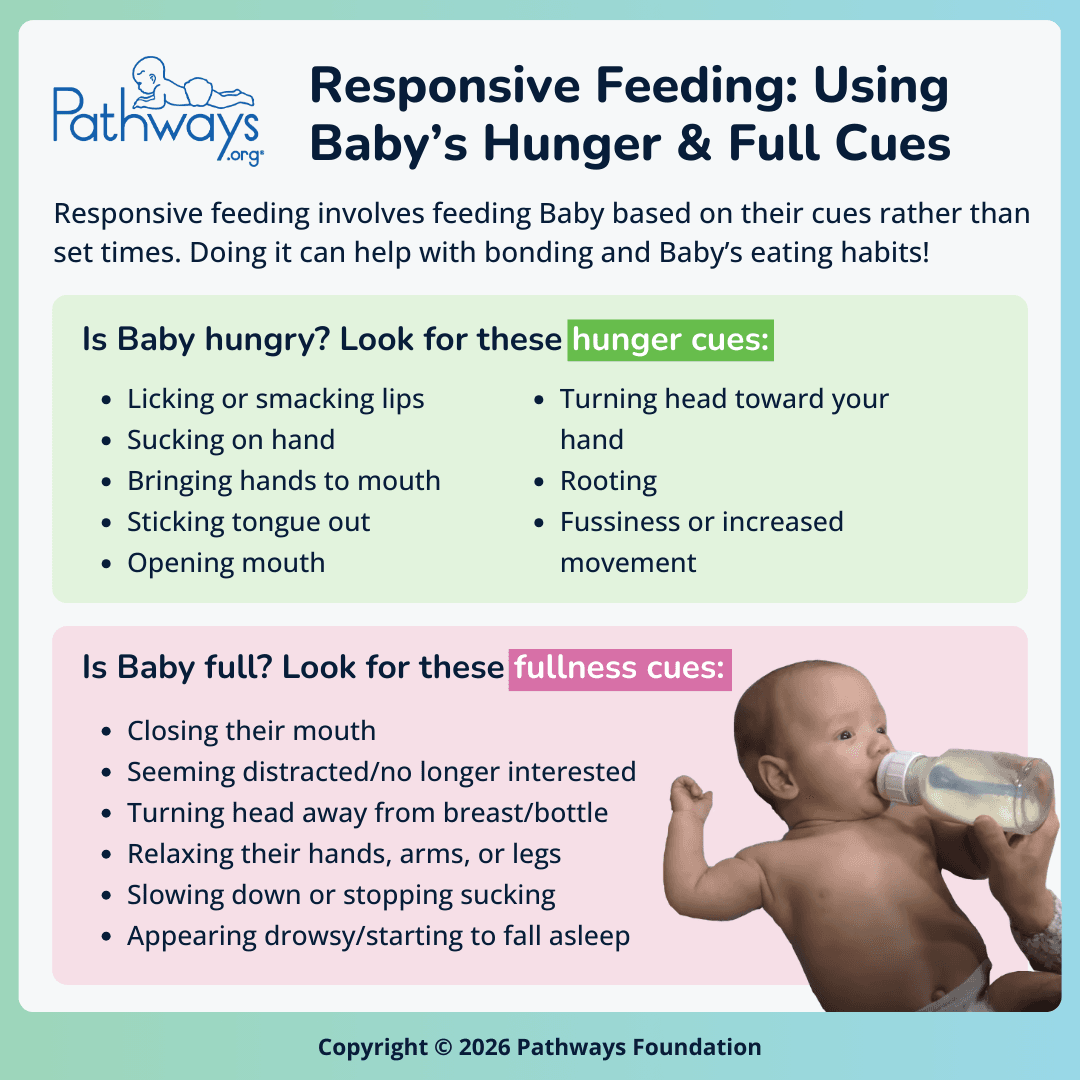
Feeding Baby on demand involves feeding them based on their hunger and fullness cues rather than set times. Doing this has many benefits, from promoting parent-baby bonding and healthy eating habits to helping Baby learn to feed themselves later on. It’s best to respond promptly, before Baby starts crying, which is a sign Baby is very hungry. You’ll learn to pick up on Baby’s cues as you spend more time with them, so don’t sweat it in the beginning!
Formula-fed babies will eventually develop a predictable feeding schedule (usually around the 1-month mark), and this is when you can start building a routine. But for breastfed babies, it’s best to continue relying on Baby’s cues rather than the clock, as this can help you produce breast milk more efficiently.
Is Baby telling you they’re hungry? Look for these hunger cues to know when Baby is ready for their next feeding:
Licking or smacking lips
Sucking on hand
Bringing hands to mouth
Sticking tongue out
Opening mouth
Turning head toward your hand
Rooting (moving their jaw/mouth or head in search of a feeding source)
Fussiness or increased movement
How Much Breastmilk or Formula to Feed Baby
Below are general infant feeding guidelines based on the American Academy of Pediatrics’ (AAP) recommendations. Know that many factors can affect how much Baby needs to eat, including the feeding method you use (breastfeeding, bottle feeding, or a combo), Baby’s weight, their health status, and growth spurts. Remember to talk with Baby’s healthcare provider about their individual needs, especially if they were born premature or with a medical condition.
Breastfed Babies
Since it’s hard to measure how much breast milk is coming out, it’s more helpful to know the signs Baby is full. Baby’s hunger and fullness cues will best help you determine when to start and stop feeding throughout the day, but breastfed newborns will generally nurse every 2 hours, or 10-12 times per 24 hours. Their feedings will gradually space out as they grow.
Breastfed babies often need smaller, more frequent feedings than formula-fed babies. This means they may wake up many times at night to feed, especially in the first few weeks. If your newborn is sleeping for longer than 4-5 hours at a time, they may need to be woken up to ensure they are eating enough.
Alternating the breast you start with each feeding can help prevent engorgement (overfilled breasts) and ensure Baby’s neck muscles are worked evenly, reducing the risk of infant torticollis.
With breastfed babies, it can be harder to tell when they’ve had enough to eat. Look for these full cues to know when to stop breastfeeding:
Closing their mouth
Seeming distracted or no longer interested in feeding
Turning their head away from the breast
Relaxing their hands, arms, or legs
Slowing down or stopping sucking
Appearing drowsy or starting to fall asleep
Bottle-Fed Babies
With bottle feeding, it’s easier to control how much breast milk or formula Baby consumes per feeding. Because of this, bottle-fed babies generally feed less frequently and on a more regular basis than breastfed babies. Bottle-fed newborns typically need to feed every 2-3 hours, or about 8-12 times per day, in the beginning. They should consume no more than 32 ounces of breast milk or formula a day by 2 months.
While responsive feeding is good to practice with bottle-fed newborns, Baby’s healthcare provider may recommend shifting to routine feedings to prevent overfeeding, an issue more commonly seen with bottle-fed babies.
Here’s what bottle feedings may look like in Baby’s first year:
First Week: 1-2 ounces of breast milk/formula per 8-12 feedings
2 Months: 2-4 ounces of breast milk/formula per 8-10 feedings
4 Months: 4-6 ounces of breast milk/formula per 6-8 feedings.
6 Months: 6-8 ounces of breast milk/formula per 4-5 feedings
9-12 Months: 6-8 ounces of breast milk/formula per 3-4 feedings
Make sure to burp Baby after every feeding and keep them upright for at least 15-30 minutes to reduce spit up.
How Much to Feed Baby When Transitioning to Solids
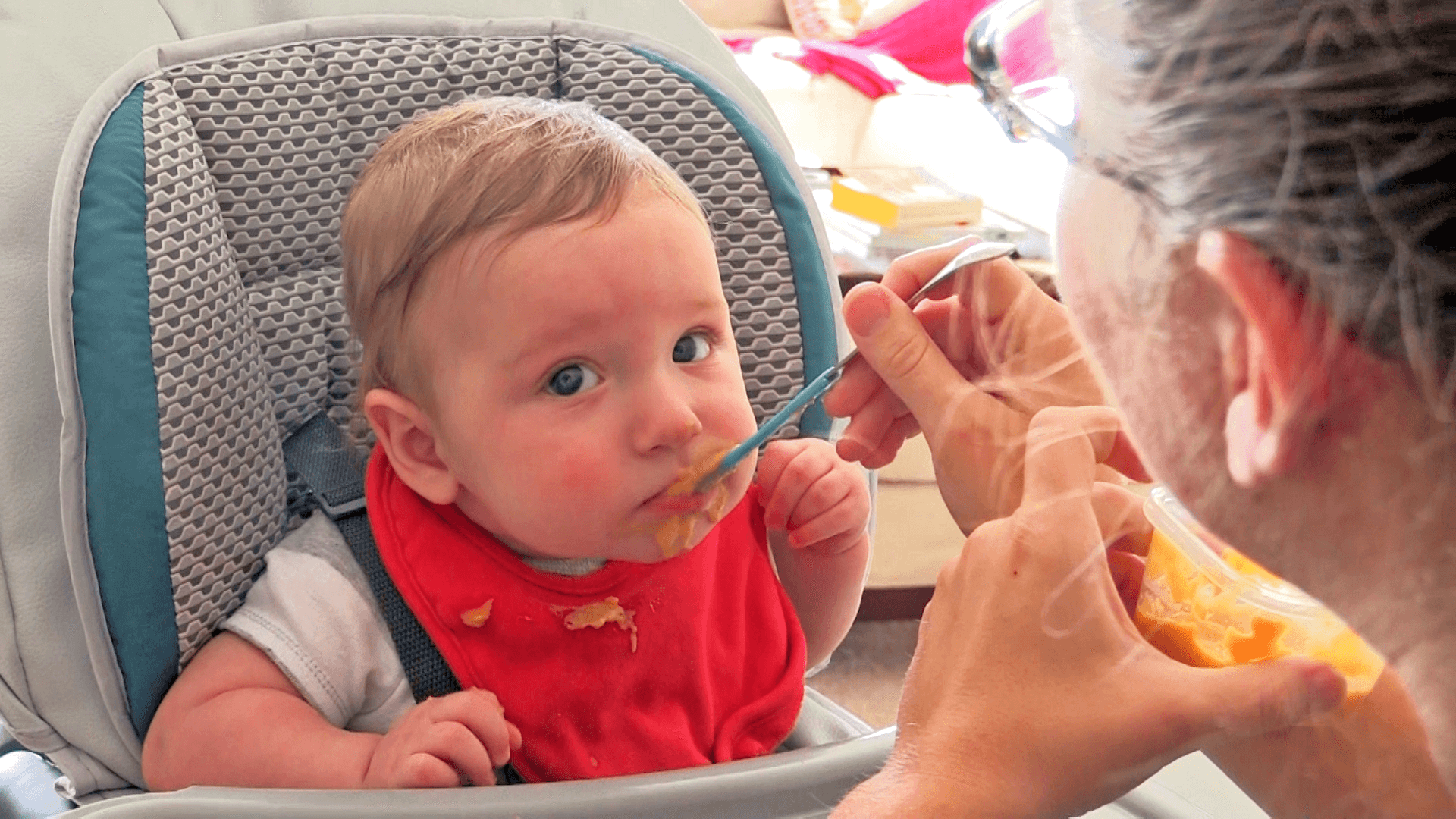
Breastmilk or formula is Baby’s main source of nutrition for their first year of life, but they’ll start needing less once they begin eating solid foods. Babies are typically developmentally ready for solids by 6 months, but it’s important to discuss this with Baby’s healthcare provider before making the transition.
Once Baby has started solids, their daily breast milk/formula needs may start to decrease from 32 ounces per day at 6 months to 24 ounces per day by 9 months and even less by 12 months. Continue discussing Baby’s diet with their healthcare provider to ensure they are getting enough calories. They can also help you decide the right time to stop breastfeeding or bottle feeding.
How to Know if Baby Is Eating Enough
For formula-fed babies, a good rule of thumb to ensure they are eating enough is that they consume about 2.5 ounces of formula per day for every pound of body weight. This is harder to do with breastfed babies, as you can’t easily measure their milk consumption.
Instead, look for these signs from the AAP that Baby is eating enough during their first week:
In their first few days, Baby loses no more than 8-10% of their birth weight
On days 1 and 2 after birth, Baby has 1-2 bowel movements per day that are blackish and tarry; on days 3 and 4, their stools start to look greenish to yellow; by day 5-7, Baby has 3-4 bowel movements that are yellow and loose with small curds.
By days 5-7, Baby has 6 or more wet diapers per day, with almost colorless or pale yellow urine
Baby seems satisfied and happy between feedings
Baby nurses at least 8-12 times per 24 hours
Baby’s healthcare provider will check Baby’s weight and ask questions about their stools, wet diapers, and feedings during each well-baby visit to ensure they are eating enough as they grow. Keeping track of Baby’s feeding sessions and diaper changes can help make these conversations easier for you both (Hint: use our diaper and feeding trackers!).
Sources
CDC. “How Much and How Often to Feed Infant Formula.” Infant and Toddler Nutrition, 1 Apr. 2024, www.cdc.gov/infant-toddler-nutrition/formula-feeding/how-much-and-how-often.html. Accessed 5 Mar. 2026.
healthychildren.org. “Amount and Schedule of Formula Feedings.” Healthychildren.org, 16 May 2022, www.healthychildren.org/English/ages-stages/baby/formula-feeding/Pages/Amount-and-Schedule-of-Formula-Feedings.aspx. Accessed 5 Mar. 2026.
healthychildren.org. “Is Your Baby Hungry or Full? Responsive Feeding Explained.” Healthychildren.org, 13 Aug. 2024, www.healthychildren.org/English/ages-stages/baby/feeding-nutrition/Pages/Is-Your-Baby-Hungry-or-Full-Responsive-Feeding-Explained.aspx. Accessed 5 Mar. 2026.
Hill, David L, and Tanya Altmann. Caring for Your Baby and Young Child: Birth to Age 5. 8th ed., American Academy of Pediatrics, Oct. 2024, publications.aap.org/aapbooks/book/768/Caring-for-Your-Baby-and-Young-Child-Birth-to-Age. Accessed 5 Mar. 2026.
Jain, Sanjeev , and Maya Bunik. “How Often and How Much Should Your Baby Eat?” HealthyChildren.org, 2 Apr. 2024, www.healthychildren.org/English/ages-stages/baby/feeding-nutrition/Pages/How-Often-and-How-Much-Should-Your-Baby-Eat.aspx. Accessed 5 Mar. 2026.
Meek, Joan. “How to Tell If Your Breastfed Baby Is Getting Enough Milk.” Healthychildren.org, 13 Jan. 2025, www.healthychildren.org/English/ages-stages/baby/breastfeeding/Pages/How-to-Tell-if-Baby-is-Getting-Enough-Milk.aspx. Accessed 5 Mar. 2026.