Helping Your Child Develop Their Grasp for Handwriting and Everyday Tasks
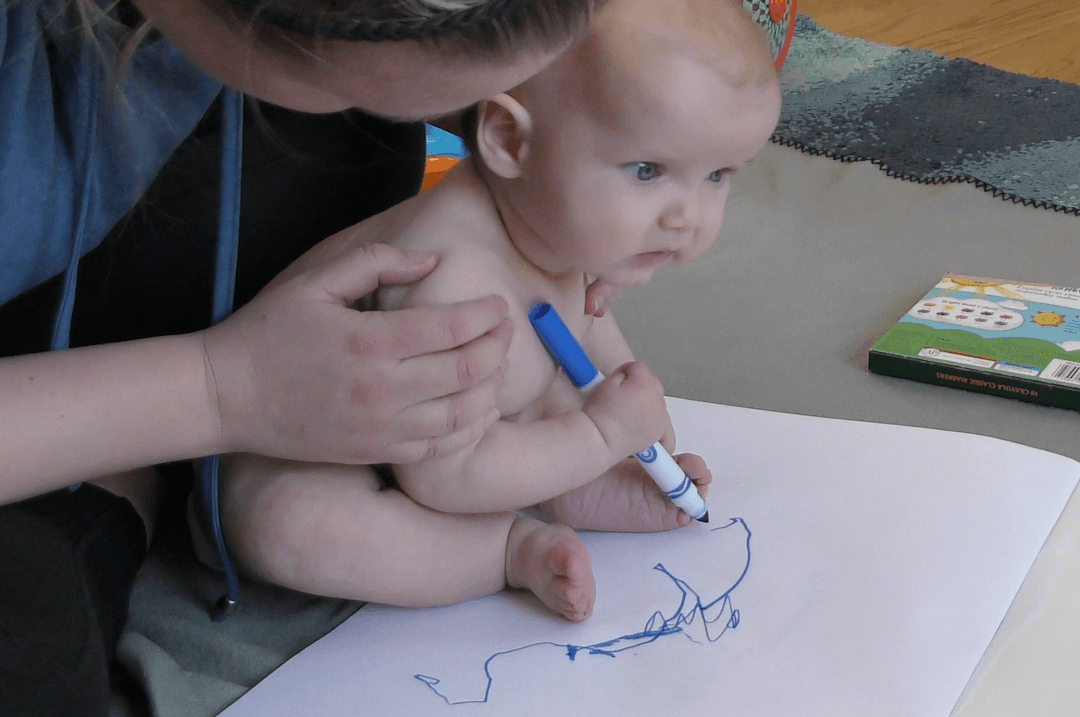
Grasp development starts at birth and progresses through predictable stages that build the foundation for handwriting and everyday skills.
Simple, age-appropriate activities can support your child’s fine motor development and encourage a more efficient grasp over time.
Every child develops their grasp at their own pace, but reach out to Baby’s healthcare provider if you have concerns.
As adults, we don’t give much thought to how we hold a pencil. Looking back at childhood, it might seem like you just figured it out one day. But it actually took years to learn!
Grasp development starts at birth and gradually becomes more refined, with a mature grasp typically developing around kindergarten age. At every stage along the way, your child is learning how to hold and control objects with increasing precision.
These skills help with far more than handwriting. Your child will use them every day for things like getting dressed, eating, and exploring their world. That’s why supporting fine motor development early on is so important!
The Stages of Grasp Development from Birth to 6 Years
Below, learn about the stages of grasp development and activities to help strengthen your child’s fine motor skills along the way!
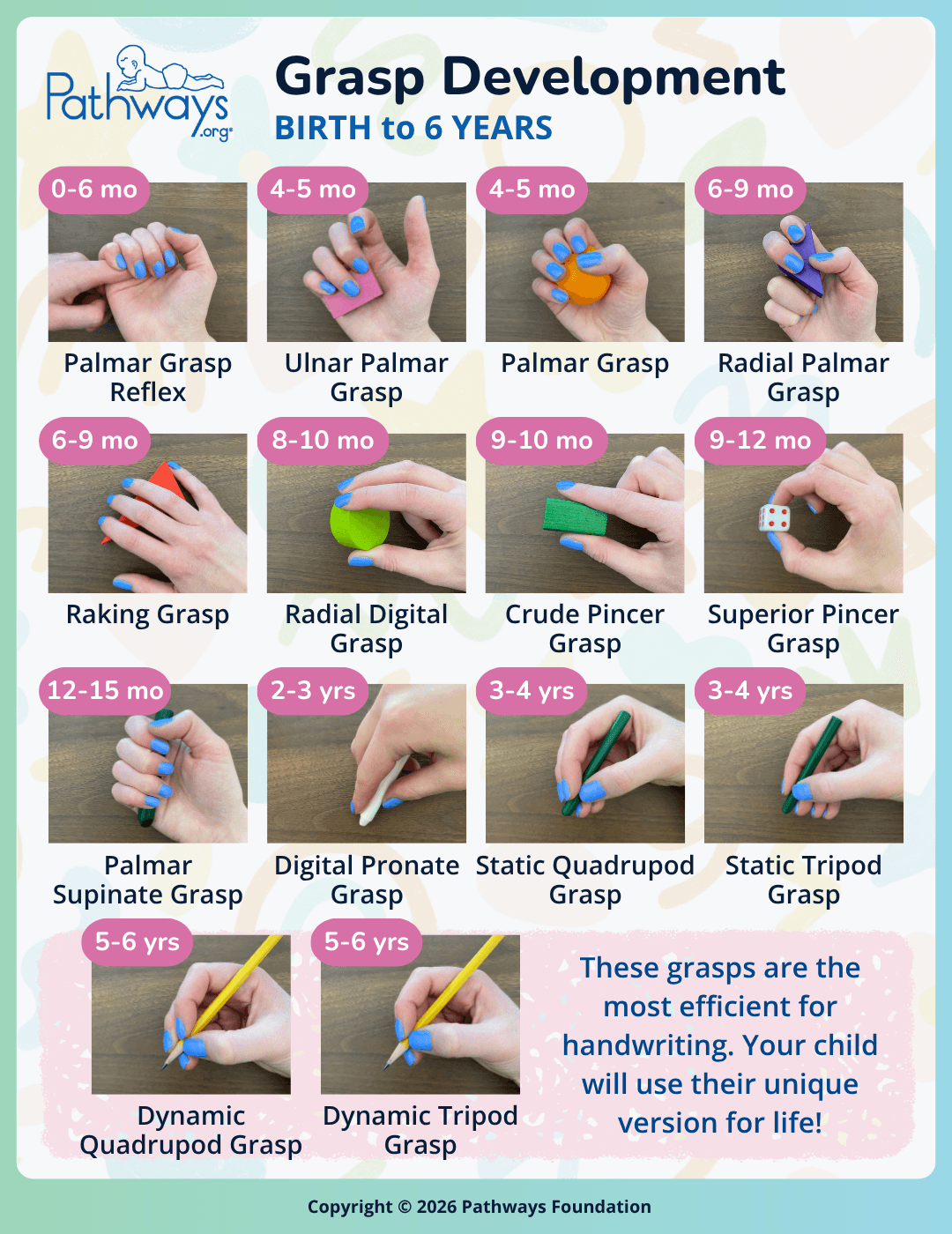
Palmar Grasp Reflex (0-6 Months)
Baby’s first grasp is a reflex, and a cute one at that! Their fingers will automatically curl around anything you put in their hands. This reflex usually fades by 5 or 6 months.
💡 Why this matters: This early reflex builds the foundation for voluntary hand control later on.
Fine Motor Activities for 0-6 Months:
Move a toy toward each of Baby’s hands to encourage their fists to open and close.
Dangle toys above Baby to swipe at while they lie on their back.
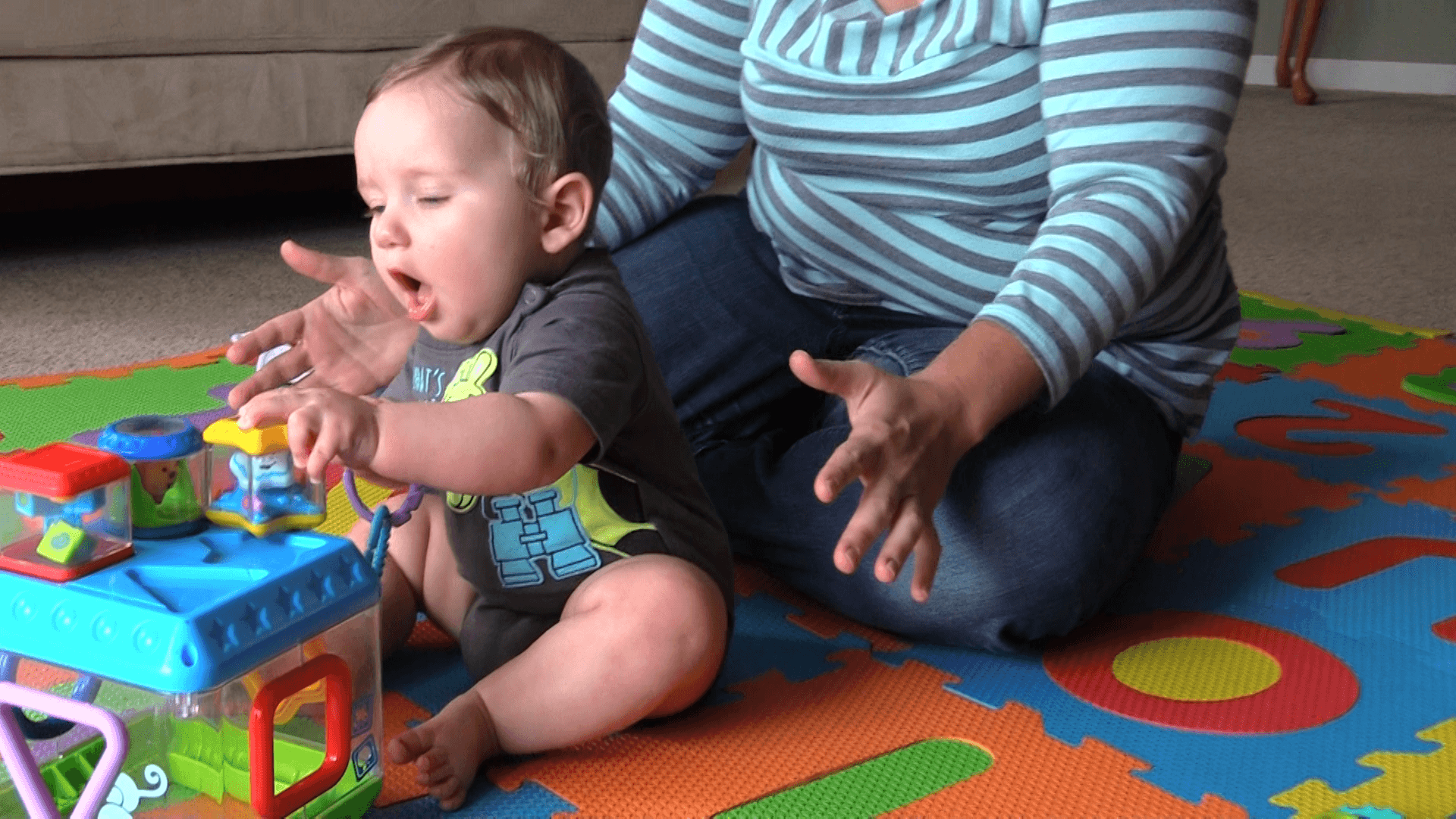
Ulnar Palmar Grasp and Palmar Grasp (4-6 Months)
As their reflexive grasp fades, Baby begins to grasp on purpose! At first, they use their whole hand and pinky side of the palm (ulnar palmar grasp). They will transition to a palmar grasp using the center of the palm and fingers (no thumb yet!) by the end of this stage.
💡 Why this matters: Baby is learning to intentionally hold and explore objects, building early skills for controlled hand use.
Fine Motor Activities for 4-6 Months:
Offer toys of different sizes and textures for Baby to explore on their high chair.
Try rolling or dropping a ball, then hand it to Baby to see what they do.
Radial Palmar and Raking Grasp (6-9 Months)
Baby starts using their thumb to help hold objects. Early on, their fingers do most of the work while the thumb helps stabilize (radial palmar grasp). During this stage, Baby also learns to use a “raking” motion to pull objects into their palm with all their fingers (raking grasp).
💡 Why this matters: Using the thumb is a big step toward more precise finger movements.
Fine Motor Activities for 6-9 Months:
Show Baby how to drop objects into a bucket and let them take a turn.
Offer baby cereal or soft foods to practice raking movements.
Let Baby pick up small toys and bring them into their hand.
Radial Digital Grasp (8-10 Months)
Baby uses fewer fingers to grasp objects. They use the pads of their thumb, index and middle fingers on the radial side of their hand.
💡 Why this matters: Using fewer fingers with more precision means Baby will soon develop a pincer grasp and fine motor control.
Fine Motor Activities for 8-10 Months:
Encourage crawling to help strengthen the arches of Baby’s hands.
Read thick board books and let Baby turn the pages.
Wrap small toys in paper and let Baby unwrap them.
-K4S-wp.png&w=3840&q=75)
Pincer Grasp (9-12 months)
Baby now uses their index finger and thumb to pick up small objects, also known as the pincer grasp! They start by using the side of their index finger and thumb (crude/inferior pincer grasp). Over time, they learn to pinch with their fingertips for more control (superior pincer grasp).
💡 Why this matters: The pincer grasp is essential for so many fine motor skills, from finger feeding to holding a pencil.
Fine Motor Activities for 9-12 Months:
Offer small, baby-safe foods for finger feeding.
Help Baby practice holding and drinking from a cup with two hands.
Provide toys with buttons to push or levers to pull.
Let Baby drop small objects into containers and take them out again.
Palmar Supinate Grasp (12-15 months)
Your toddler starts holding utensils in their whole fist, with the thumb on top. They use their whole arm to move it.
💡 Why this matters: This grasp marks the beginning of early drawing. Your toddler may attempt to make marks on paper before true scribbling starts.
Fine Motor Activities for 12-15 Months:
Provide egg-shaped or chunky crayons for making marks on paper.
Experiment with non-sharp utensils for self-feeding.
Try stacking blocks to make a tall tower.
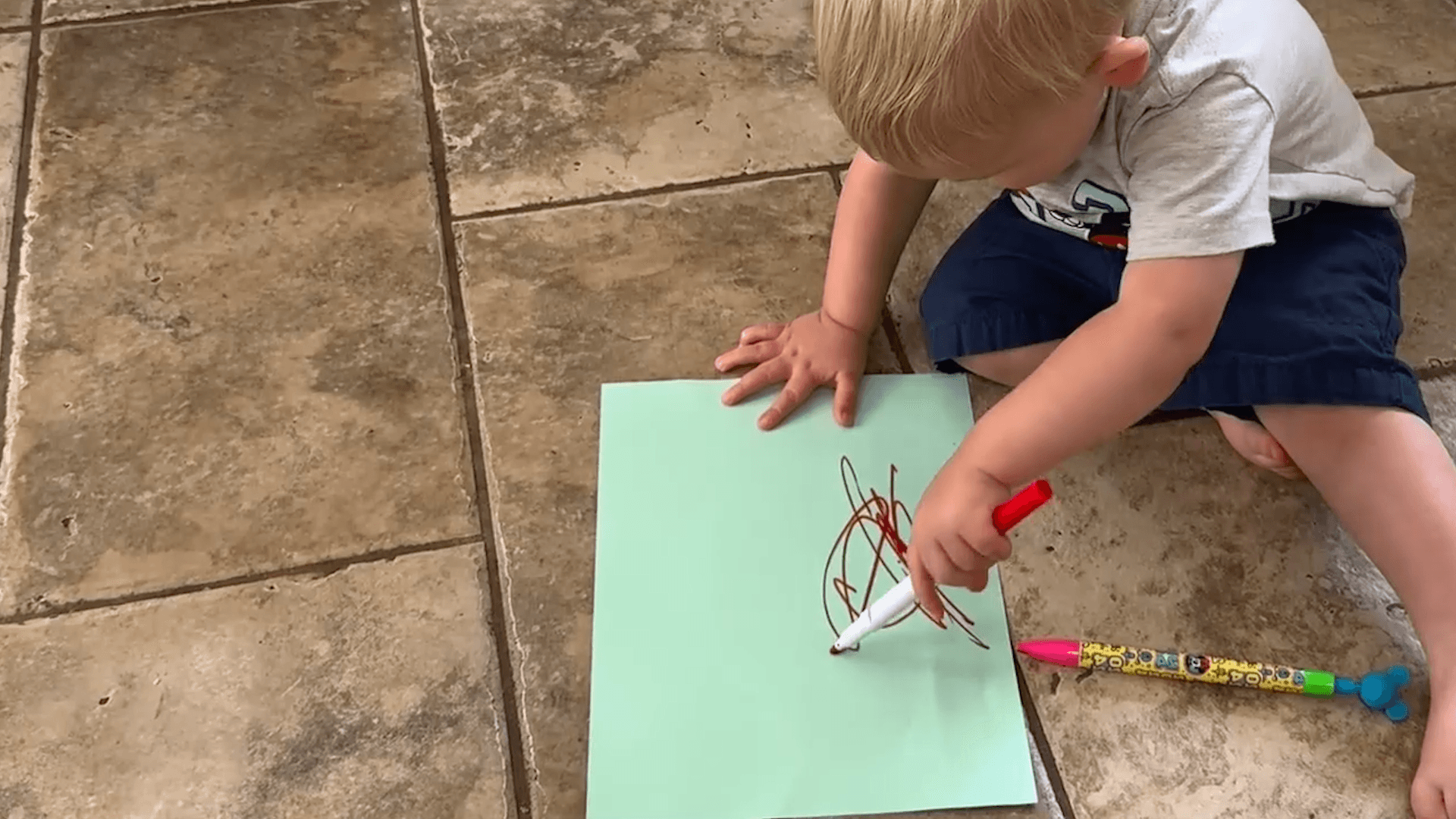
Digital Pronate Grasp (2-3 yrs)
Your toddler holds a utensil with all their fingers and their palm facing down. They still use mostly whole-arm movements to control it. You may also start to notice hand preference emerging.
💡 Why this matters: Your child is gaining more control, even though their movements are still large and less precise.
Fine Motor Activities for 2-3 Years:
Provide chunky or triangle crayons for scribbling.
Try stringing large beads or pasta onto a string.
Offer stickers to peel and place on paper.
Try scooping and pouring water or sand into small containers.
Pour and mix baking ingredients in a bowl.
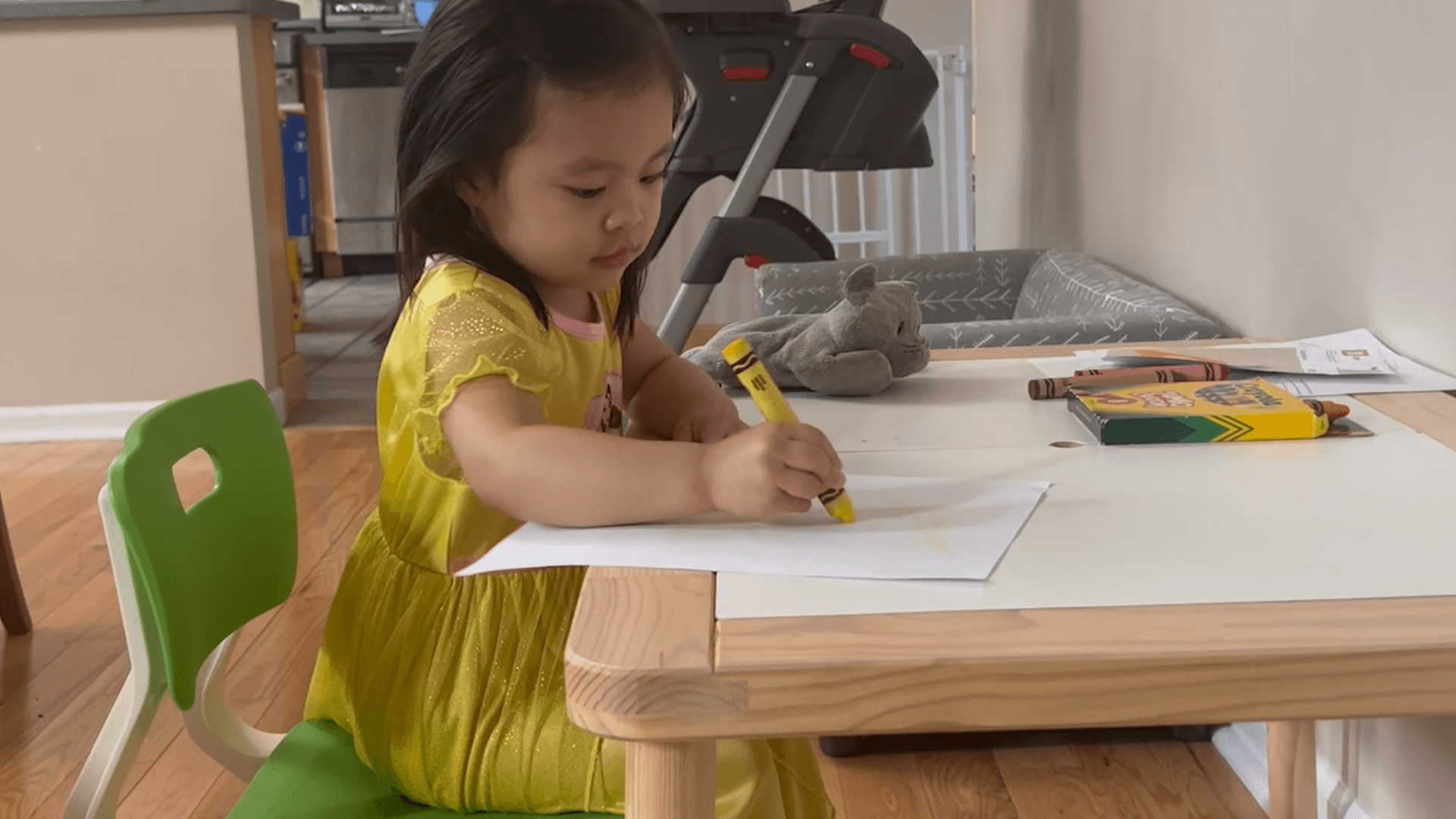
Static Quadrupod and Tripod Grasp (3-4 years)
Your child begins using the whole pads of their fingers to hold a utensil:
Quadrupod: held with four fingers; fourth finger (ring) is tucked under the utensil
Tripod: held with three fingers; third finger (middle) is tucked under the utensil
Their fingers stay still (static), while movement comes from the wrist, elbow, and shoulder.
💡 Why this matters: This grasp allows for better control and is a big step toward more refined drawing and writing.
Fine Motor Activities for 3-4 Years:
Try squeezing spray bottles, turkey basters, or tongs.
Offer crayons or chalk for tracing, coloring, and connecting dots.
Play with chunky puzzles, blocks, or pegboards.
Encourage water and sandbox play.
Hide small objects in playdough for your child to pick out.
Dynamic Quadrupod and Tripod Grasp (5-6 yrs):
Your child is now using a mature grasp! They use four or three fingertips to hold the utensil at an angle. Their fingers now move (dynamic) to control it, allowing for more precise and controlled writing.
💡 Why this matters: This is the most efficient grasp for handwriting, helping with control, endurance, and neatness.
Fine Motor Activities for 5-6 Years:
Try shaping different objects with putty or playdough.
Practice tracing and copying complex shapes like stars and diamonds.
Encourage writing their name and numbers.
Play card and board games.
Try fingerpainting or using paintbrushes to make art.
Offer cutting and pasting activities with safety scissors and non-toxic glue.
Tips to Encourage a Proper Grasp
When your child starts drawing and writing, use these tips to encourage a proper grasp and provide support for common issues:
Demonstrate good posture: Your child should sit upright with their feet flat and knees at a 90° angle. Use a step stool or child-sized table if needed.
Build shoulder stability: Have them draw while lying on their tummy or on a slanted surface like a binder. Or, try non-drawing activities like crawling, climbing, swimming, or pushing/pulling.
Support good wrist positioning: Do upright drawing activities on an easel, chalkboard, or paper taped to the wall.
Encourage using both hands: Show your child how to hold the paper with one hand while drawing or writing with the other.
Strengthen the “thumb side” (radial) of the hand: Have your child hold a small object (like a coin or marble) with their ring and pinky fingers while drawing. You can also use short or broken crayons to encourage fingertip use.
Let development happen naturally: Avoid forcing a mature grasp too early. Each stage builds important strength and coordination!
Did you know your child’s sensory development helps with handwriting? A strong sense of body awareness (proprioception), good balance (vestibular sense), and a mature visual system are important for things like knowing how much pressure to apply, making precise hand movements, and using hand-eye coordination!
Have Concerns About Your Child’s Grasp?
Every child develops their grasp at their own pace! Just focus on providing opportunities for them to explore with their hands and fingers, and progress will come. A “mature” or “proper” grasp can also look very different from child to child. If you have any concerns, especially as your child approaches school-age, talk with their healthcare provider. They may refer your child to an occupational therapist to address potential issues with strength, posture, and fine motor control.
Sources
Cleveland Clinic. “Finger to Thumb: What to Know about the Pincer Grasp.” Children’s Health, 23 May 2023, health.clevelandclinic.org/pincer-grasp. Accessed 16 Apr. 2026.
healthychildren.org. “Newborn Reflexes.” Healthychildren.org, American Academy of Pediatrics, 8 Mar. 2022, www.healthychildren.org/English/ages-stages/baby/Pages/Newborn-Reflexes.aspx. Accessed 16 Apr. 2026.
Hill, David L, and Tanya Altmann. Caring for Your Baby and Young Child: Birth to Age 5. 8th ed., American Academy of Pediatrics, Oct. 2024, publications.aap.org/aapbooks/book/768/Caring-for-Your-Baby-and-Young-Child-Birth-to-Age. Accessed 5 Mar. 2026.
Taylor, Allison. “When Should I Be Concerned about My Child’s Grasp?” Associates in Pediatric Therapy, 17 Apr. 2023, kidtherapy.org/when-should-i-be-concerned-about-my-childs-grasp/. Accessed 16 Apr. 2026.