Imitation Play: What It Means When Your Toddler Copies You During Play
-H7s0gU.png&w=3840&q=75)
Imitation helps your toddler make sense of the world, and it’s a sign they look up to you!
From executive function and communication skills to empathy and confidence, imitation play helps build many important skills for your child’s development.
Encouraging imitation play is all about giving your toddler opportunities to observe and act out what they see, like while doing chores together or engaging in pretend play.
Is your toddler suddenly copying the things you do during playtime? Maybe they have started telling their dolly to eat their veggies, repeat the exaggerated sigh you do sometimes, or even use your signature greeting and cadence while talking on their toy phone.
As the saying goes, “imitation is the sincerest form of flattery”. And in this case, it’s true! Your toddler looks up to you for guidance in every aspect of life, and imitation is one of the sweetest signs of it. Learn why your child copies you, and why it’s important for their development!
Why does my toddler copy what I do?
No, your toddler is not mocking you. Imitation is their way of making sense of the world (and themselves)! It’s a tool they’ve used to learn since late infancy, copying your facial expressions to figure out feelings or repeating speech sounds to form their first words. As a baby, imitation is more of a reflex, or done randomly. Toddlerhood is when they start imitating more consciously. They’ll use imitation during pretend play to develop different life skills, practice social situations, and exercise their independence.
Why Imitation Play is So Good for Child Development
Imitation play can be adorable to watch, even if it’s a little embarrassing at times (”That’s how I sound when I yell at the dog?!”). But it’s not just cute! Imitation does a lot of heavy lifting for your toddler’s development. Here are a few important skills it supports:
Executive function skills: These skills are what help your child imitate in the first place! They use their working memory to remember your mannerisms, words, or actions and repeat them later during play. Through imitation, they learn other executive function skills like emotional regulation and problem-solving.
Motor skills: Imitation helps them learn movements like clapping, kicking a ball, or twisting a bottle cap.
Social-emotional skills: Your child will learn social-emotional skills like empathy by watching and repeating how you respond to others’ feelings. For example, they’ll learn how to comfort a friend when they are sad by imitating your own comforting gestures toward them and their siblings.
Communication skills: Through imitation, your child learns how to start and hold a conversation, read other people's body language, and form appropriate responses. Imitation is also great for learning new words!
Confidence and independence: Acting out real-life scenarios during play prepares your child for new social situations, like ordering their own food at a restaurant. The more they practice, the more capable they feel, building that “I can do it” attitude that fuels independence.
How can I encourage imitation play?
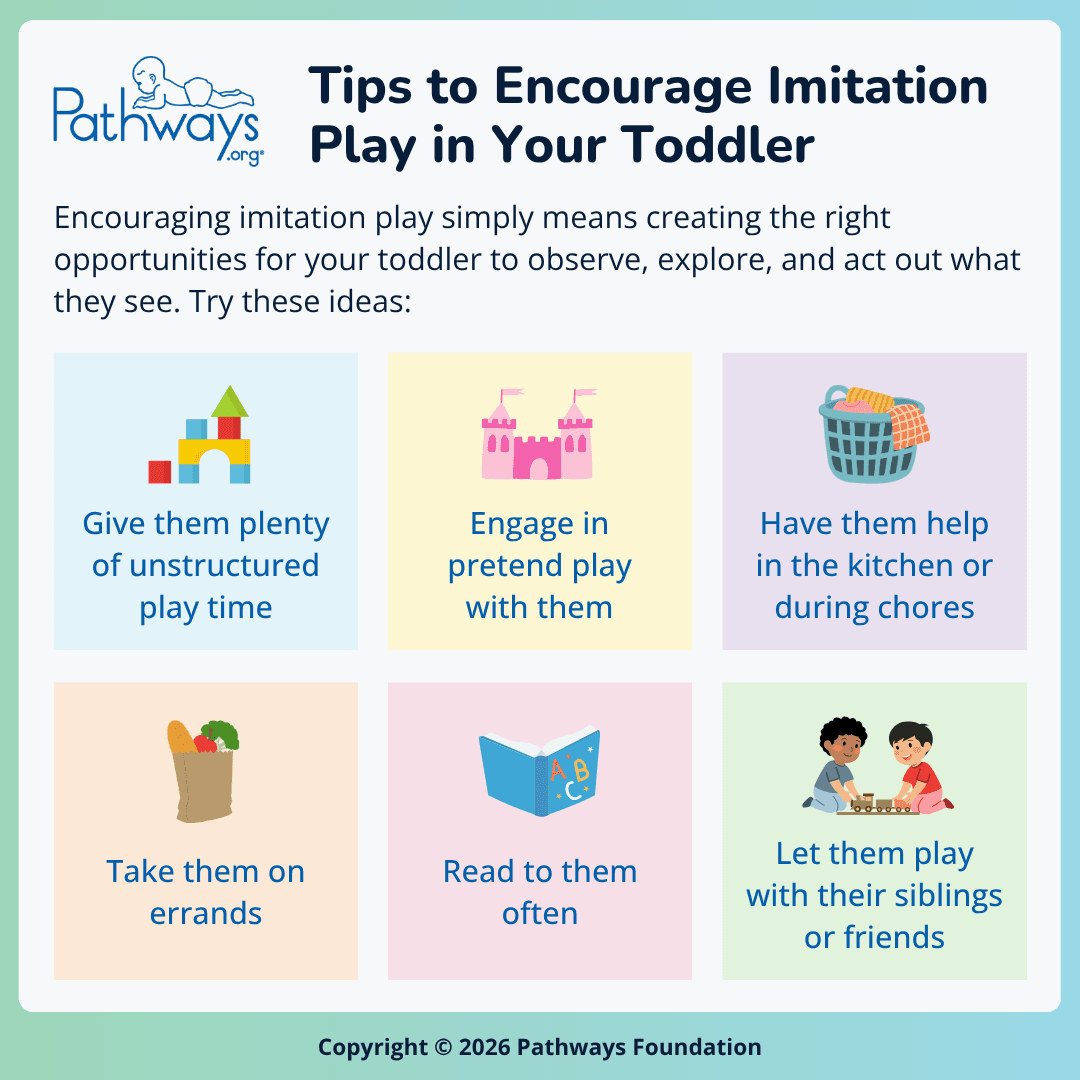
Your toddler is naturally motivated to copy you and others, so encouraging it doesn’t require much effort! The key is simply creating the right opportunities for them to observe, explore, and act out what they see. Here are some easy ways to do that:
Give them plenty of unstructured play time, allowing them to lead rather than having them follow set rules.
Engage in pretend play with them, so they can act out different social situations (Here are 30 ideas!). Building a costume bin or letting them play with safe kitchen tools can help them really get into character.
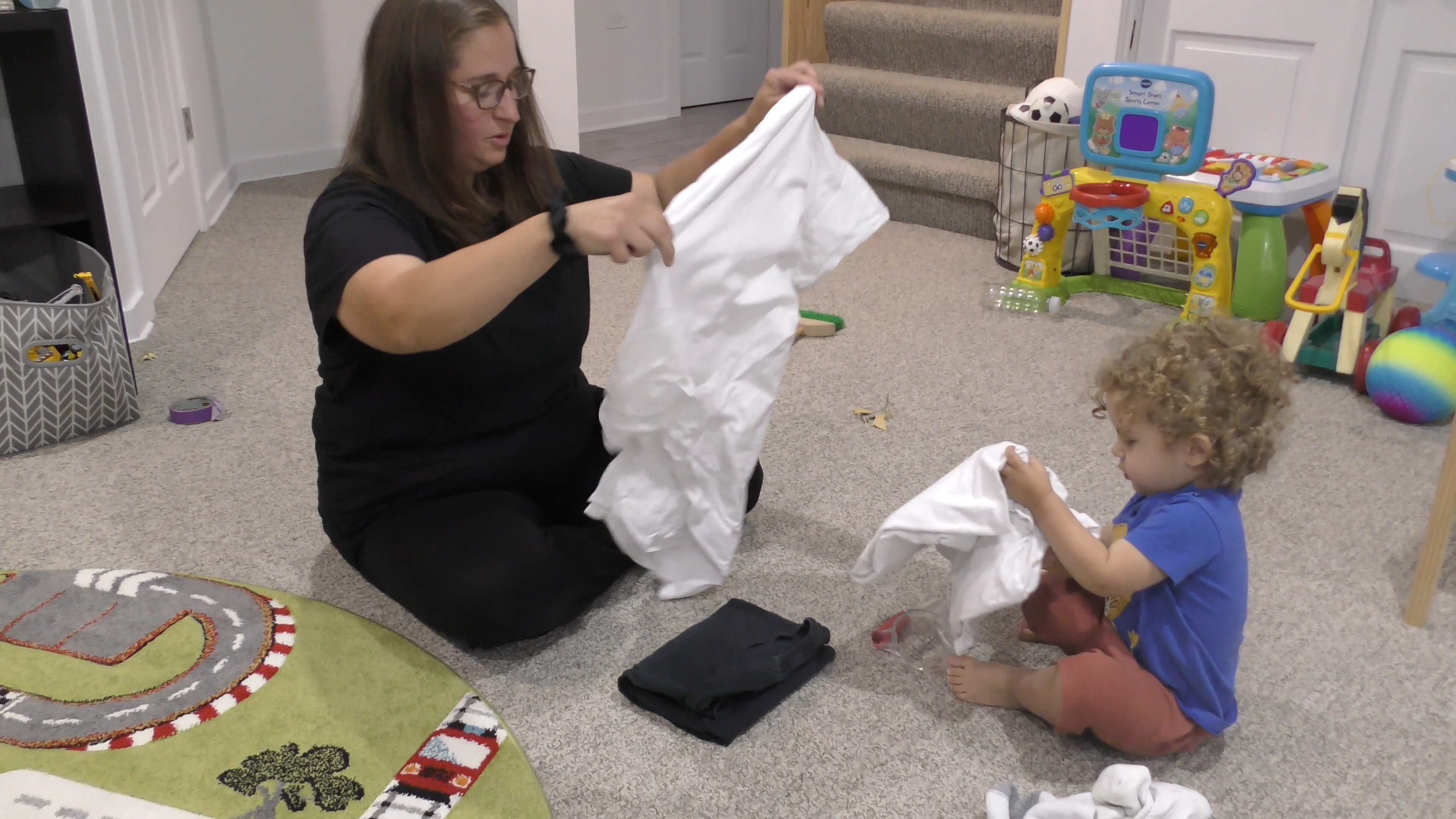
Have them help in the kitchen or during chore time so they see how you plan and follow steps.
Take them on errands, letting them observe how you interact with others.
Read to them often, so they can learn about qualities or concepts you want them to pick up on, like kindness, patience, or good sportsmanship when winning or losing a game.
Let them play with their siblings or friends, so they can see how other kids interact and observe skills like sharing.
Remember, your child is always watching you!
Because your toddler is so interested in imitation at this age, you’ll want to watch what you say around them, and be careful of how you model behaviors. If a bad word slips out when you stub your toe, say “Oops, Daddy shouldn’t have said that word.” Or if you lose your cool at your kid’s 50th “Mommy” that day, be sure to apologize and demonstrate self-regulation strategies, like taking a few deep breaths. We’re all human, so modeling perfect behavior 100% of the time is impossible. What matters is that you acknowledge when you do slip up (even if it’s not right away) and turn it into a teachable moment for your child.
Sources
Jones, Susan S. “The Development of Imitation in Infancy.” Philosophical Transactions of the Royal Society of London. Series B, Biological Sciences, vol. 364, no. 1528, 27 Aug. 2009, pp. 2325–35. PMC PubMed Central, 10.1098/rstb.2009.0045. Accessed 3 June 2026.
Malcom, Kelly. “Studies Shed Light on Toddler Development | Duke Today.” Duke Today, Duke University, 30 June 2000, https://today.duke.edu/2000/06/toddler630.html. Accessed 3 June 2026.
Sanford Health Parenting Services. “When Imitating Others, Toddlers Learn New Skills.” Sanford Health, 19 Aug. 2025, https://news.sanfordhealth.org/parenting/imitation-in-toddlers/. Accessed 3 June 2026.
“Social Development: 2 Year Olds.” HealthyChildren.Org, American Academy of Pediatrics, 1 Sept. 2022, https://www.healthychildren.org/English/ages-stages/toddler/Pages/Social-Development-2-Year-Olds.aspx. Accessed 3 June 2026.