How the “Flavor Window” Shapes What Baby Will Eat Later On
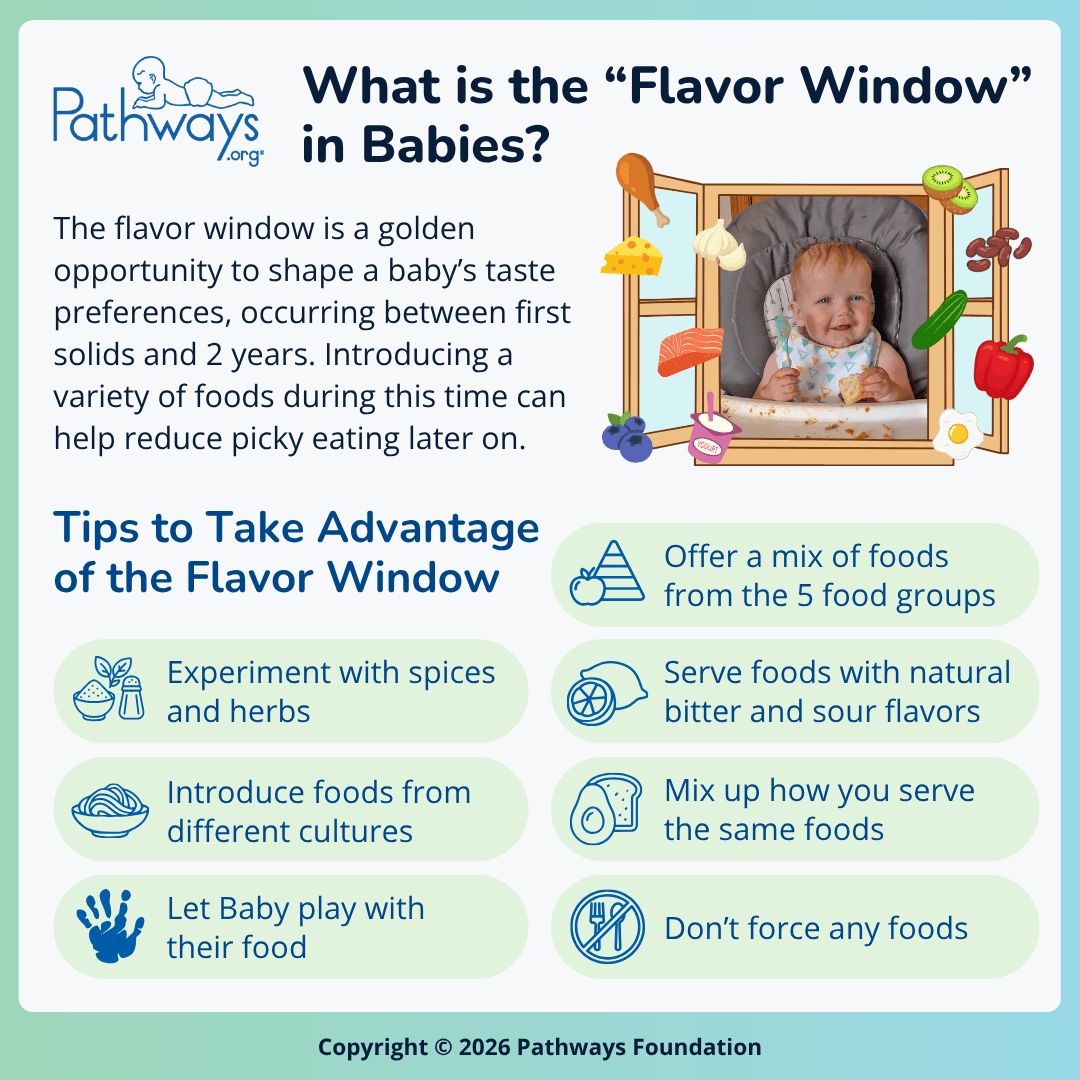
The "flavor window" is a developmental phase when babies are most open to trying new flavors, making it the ideal time to introduce a wide variety of foods.
Flavor learning begins before birth, but the most impactful shaping of taste preferences happens once solid foods begin.
Taste preferences can still change after the flavor window, so don’t worry if your little one experiences typical picky eating despite your best efforts to expand their palate as a baby.
It turns out that how you feed Baby in those first few months of solids really matters! Little ones form most of their lasting taste preferences by 9 months old, which is a big reason why the American Academy of Pediatrics recommends offering a wide range of flavors, textures, and colors early on. Taking care to give Baby a variety of foods during what’s known as the “flavor window” can help reduce picky eating down the road, as well as provide Baby with more nutrients that support their growth.
What is the “flavor window” in babies?
Scientists recognize the flavor window as a golden opportunity to shape a baby's taste preferences, as this is when they are naturally most open to trying a variety of foods. While the research doesn’t agree on an exact age range, this sensitive period in flavor learning lies somewhere between the time a baby starts solids (typically around 6 months) and 2 years, with peak flexibility around 6-9 months.
But the flavor window is about more than forming early taste preferences! It’s also an important time to get Baby familiar with different textures, smells, and colors of food. Getting them comfortable with the varied sensory experience of eating early on is another way to help reduce picky eating.
Can a baby’s taste preferences form during pregnancy?
In the womb, Baby is first introduced to different flavors from their mother’s diet, which get transmitted to the amniotic fluid and swallowed by Baby. If they are given breast milk, this is another way they’ll experience new flavors—more aromatic ones such as garlic, mint, or vanilla tend to come through most noticeably. While studies have shown that babies can detect these familiar flavors and may be more accepting of them once they start solids, there is no guarantee that this early exposure will shape their long-term food preferences.
What we do know for sure is that babies are born naturally preferring sweeter flavors, and it’s part of why they take so readily to the sweet taste of breast milk! But the most significant shaping of their taste preferences begins with their first solid foods.
Are there certain foods I should introduce before others?
Some people believe that introducing veggies before fruit will increase their baby's chances of becoming a veggie lover. While there is some research suggesting early vegetable exposure can boost acceptance, the evidence isn't strong enough for the AAP to recommend any specific order of introduction.
It’s also a common myth that delaying allergenic foods (peanuts, eggs, fish, etc.) will prevent allergies. However, studies have found that early introduction may actually help reduce the risk of developing allergies. You can do this safely with guidance from Baby’s healthcare provider.
What’s most important is that you expose your little one to all kinds of foods (in baby-safe forms) when they are first starting solids. That said, there are a few foods and beverages babies should limit or avoid until they are older. These include things like honey, cow’s milk, and juice; choking hazards like grapes, popcorn, and nuts; and salt and sugar.
Check out our blog on baby superfoods for 10 nutrient-packed foods to try when Baby starts solids.
Note: Remember to talk to Baby’s healthcare provider before starting solids and follow their guidance if you are unsure which foods are safe to try first.
Tips to Take Advantage of the Flavor Window
Follow these tips to help Baby expand their palate! See specific tips for transitioning to solids here.
Don’t be afraid to experiment with spices and herbs! While babies under 1 year old should avoid salt, added sugars, and spicy seasonings like cayenne pepper, there are many spices and herbs you can try mixing into their food. A dash of cinnamon on plain applesauce or garlic powder and dried chives on their potatoes are great ways to introduce new flavors. Bonus: spices like turmeric and mild/sweet paprika add natural colors to food while providing many health benefits, too!
Offer a mix of foods from the five main food groups. Make sure Baby tries a variety of fruits, veggies, grains, proteins, and dairy products so they experience a balanced diet with all the nutrients they need.
Introduce foods from different cultures. This is not only an easy way to explore unique flavor profiles, but it also encourages an appreciation for cultures outside your own! Baby can try rice pudding with different cultural variations, salt-free hummus, tropical fruits… the possibilities are endless! Just be sure to make baby-safe modifications as needed, like using sodium-free seasonings or removing choking hazards.
Serve foods with natural bitter and sour flavors. Babies are born with a natural aversion to bitter or sour-tasting foods. Giving Baby a chance to try these foods on their own can help them learn to enjoy those flavors. For example, let Baby gnaw on half of a lemon (bigger than their mouth) with the seeds removed, try plain Greek yogurt, or eat bitter greens such as spinach and broccoli.
Let Baby play with their food! Exposing Baby to the feel of different foods, even if they don’t reach their mouth, is important during this stage. Food play can help Baby with sensory processing and get them used to new textures in a low-pressure way.
Mix up how you serve the same foods. For example, you can try serving broccoli as a puree one day and in steamed, baby-safe pieces another day. Or you can introduce a new food with a familiar one, like shredded cheese sprinkled on top of the broccoli. This is an easy way to introduce multiple textures.
Don’t force any foods. It can take 10-15 tries for a baby to enjoy a new food, so be patient and keep offering it without pressure.
Can my baby’s taste buds change after the flavor window?
Absolutely! A baby’s taste preferences aren’t locked down once the flavor window closes. They can still learn to love their greens or the textures they once turned away when they are older. Even adults can change their minds about foods they have disliked since they were children.
So don’t sweat it if your child becomes a picky eater, despite all your best efforts to introduce a variety of food when they were a baby. Picky eating is a very common phase for young children, and one most grow out of! Just keep offering a variety of foods at the dinner table without pressure. They may surprise you one day!
Sources
Blossfeld, I., et al. “Texture Preferences of 12-Month-Old Infants and the Role of Early Experiences.” Food Quality and Preference, vol. 18, no. 2, 2007, pp. 396–404, https://doi.org/10.1016/j.foodqual.2006.03.022.
Borowitz, Stephen M. “First Bites—Why, When, and What Solid Foods to Feed Infants.” Frontiers in Pediatrics, vol. 9, 2021, article 654171, https://doi.org/10.3389/fped.2021.654171.
Cox, Amanda, and Michael Pistiner. “When to Introduce Egg, Peanut Butter & Other Common Food Allergens to a Baby.” HealthyChildren.org, American Academy of Pediatrics, 12 June 2025, www.healthychildren.org/English/healthy-living/nutrition/Pages/when-to-introduce-egg-peanut-butter-and-other-common-food-allergens-to-your-baby-food-allergy-prevention-tips.aspx.
Harris, Gillian, and Helen Coulthard. “Early Eating Behaviours and Food Acceptance Revisited: Breastfeeding and Introduction of Complementary Foods as Predictive of Food Acceptance.” Current Obesity Reports, vol. 5, no. 1, 2016, pp. 113–20, https://doi.org/10.1007/s13679-016-0202-2.
Maier-Nöth, Andrea, et al. “The Lasting Influences of Early Food-Related Variety Experience: A Longitudinal Study of Vegetable Acceptance from 5 Months to 6 Years in Two Populations.” PLOS ONE, vol. 11, no. 3, 2016, e0151356, https://doi.org/10.1371/journal.pone.0151356.
Mennella, Julie A., and Sara M. Castor. “Sensitive Period in Flavor Learning: Effects of Duration of Exposure to Formula Flavors on Food Likes during Infancy.” Clinical Nutrition, vol. 31, no. 6, 2012, pp. 1022–25, https://doi.org/10.1016/j.clnu.2012.05.005.
Mennella, Julie A., et al. “Flavor Programming during Infancy.” Pediatrics, vol. 113, no. 4, 2004, pp. 840–45, https://doi.org/10.1542/peds.113.4.840.
Mennella, Julie A., et al. “Prenatal and Postnatal Flavor Learning by Human Infants.” Pediatrics, vol. 107, no. 6, 2001, p. e88, https://doi.org/10.1542/peds.107.6.e88.
Müller, Carina, et al. “The Sweet Tooth of Infancy: Is Sweetness Exposure Related to Sweetness Liking in Infants up to 12 Months of Age?” British Journal of Nutrition, vol. 129, no. 8, 2023, pp. 1462–72, https://doi.org/10.1017/S0007114522002628.
“Tips for Introducing Solid Foods.” HealthyChildren.org, American Academy of Pediatrics, 13 Aug. 2024, www.healthychildren.org/English/ages-stages/baby/feeding-nutrition/Pages/tips-for-introducing-solid-foods.aspx.